

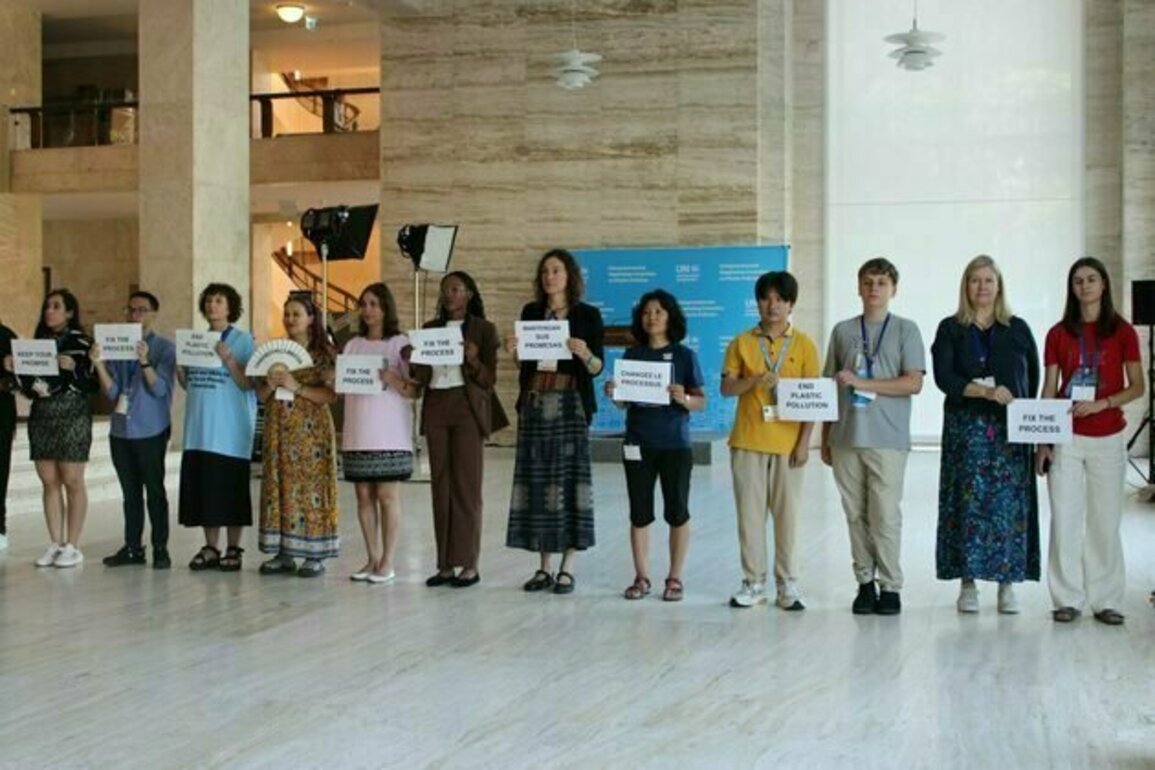
Member States and Chair Fail to Act in Stocktake Plenary
Geneva, Switzerland Plastic pollution is accumulating in our water, air, food, and bodies while the majority of Member States continue to allow themselves to be bullied by a small group of petroleum-producing nations.Their failure to call for a vote at todays stocktake plenary has put the fate of the plastics treaty in jeopardy.
After years of stalled talks and only a few days left to secure a strong treaty, the stocktake plenary was a critical moment for the Chair and Member States to turn things around by calling for a vote, in order to break the paralysis of consensus-based decision-making. However, while many countries expressed frustration at the lack of progress and explicitly called out petro-state stalling tactics,no country took action to unlock negotiations and exercise democracy.
Its unbelievable were still stuck with this bloated text full of brackets at this stage of the negotiations, says Salisa Traipipitsiriwat of Environmental Justice Foundation (EJF) Thailand. Consensus is clearly holding us back from reaching agreement, yet still countries did not have the courage to take action. Yes, voting is politically sensitive, but we need to put it on the table if we are to secure a strong treaty. Its now or never.
We have one week left for countries to have the courage to follow through on their promises. The self-called High Ambition Coalition must live up to its title.
The Chairs actions were also to blame for failing to meet this consequential moment in the talks.His proposal of work repeated the same methods that have been proven ineffective, and in an abrupt move, he cut the plenary short before all Member States queued were given the mic, which undermines a process that is supposed to be Member-led.
Countries cannot remain locked in a fatally flawed process and expect a different outcome. By staying silent, ambitious countries are playing into the hands of petro-states and the petrochemical and fossil fuel industry.
Thais Carvajal of Zero Waste Alliance Ecuador states, "To move forward, its time to bring the vote to the table. The clock is ticking, and we cannot remain stuck in a broken process. A treaty that fails to deliver impact is far more dangerous than one that fails to please everyone."
The progressive proposals have the numbers 100+ countries support a binding global production phasedown target, 100+ countries support a binding phaseout of harmful products and chemicals, 150+ countries support a strong financial mechanism, 120+ countries support a standalone article on health. Now is the time to seize the momentum and show the world that multilateralism can still solve global problems.
Merrisa Naidoo of GAIA Africa states, A stronger procedural action to unlock voting could have advanced text negotiations from the stalemate that continues to deadlock urgent action to address the plastics crisis. We are not asking for charity, we are demanding courage.
Press contacts if you wish to know more:
Global: Claire Arkin |[email protected]| +1 (973) 444 4869
Regional:
Africa: Carissa Marnce |[email protected]| +27 76 934 6156
Latin America: Camila Aguilera |[email protected]| +56 9 8913 6198
Asia & the Pacific:Robi Kate Miranda |[email protected] +63 927 585 4157
###
GAIAis a worldwide alliance of more than 1,000 grassroots groups, non-governmental organizations, and individuals in over 90 countries. With our work, we aim to catalyze a global shift towards environmental justice by strengthening grassroots social movements that advance solutions to waste and pollution. We envision a just, zero waste world built on respect for ecological limits and community rights, where people are free from the burden of toxic pollution, and resources are sustainably conserved, not burned or dumped.
GAIA